How To Train A Dominant Shih Tzu
Who Is In Control, You Or Your Shih Tzu?
You’re on a quiet walk with your Shih Tzu, and everything’s fine until another dog rounds the corner.
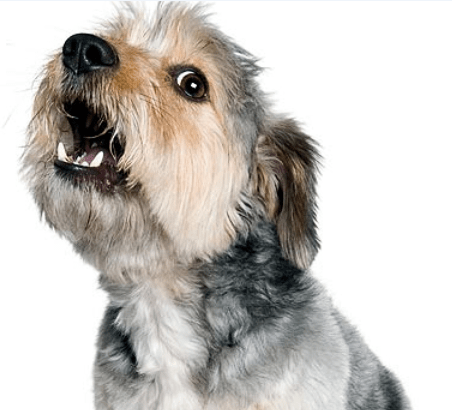
Then your small, usually sweet-natured dog turns into a lunging, barking mess, way out of proportion to their size.
If you’ve been there, you’re not alone, and it’s not because your dog is secretly running the household.
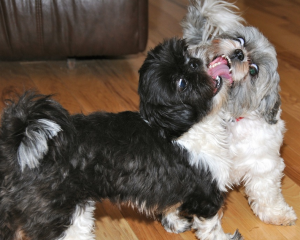
You have tried everything to stop this behavior.
That’s the label a lot of owners reach for: dominance.
It’s worth pausing on that word, because the idea of Shih Tzu dominance as some kind of power struggle has mostly been replaced by newer research.
What looks like a dog trying to be “alpha” is usually a dog that’s anxious and doesn’t know who’s in charge of keeping things safe.
So what’s actually going on?
When there’s no clear leader in the house, a Shih Tzu can end up feeling like the job falls to them, and that job is exhausting.
A dog that thinks it has to protect you is not a dog enjoying its walk.
Dogs aren’t complicated creatures underneath all this.
They want to feel secure, and when they don’t, they fall back on the instincts that helped their ancestors survive.
If a dog is regularly allowed to set the pace on walks or guard food and toys without any pushback, it starts to see itself as the pack’s only line of defense.
Add in normal environmental stress, a new noise, an unfamiliar dog approaching, and that dog goes on high alert because it thinks no one else is watching the perimeter.
It’s not meanness.
It’s a dog stuck doing a job nobody assigned them and nobody wants them to have.
Just Follow The Leader
Dogs are pack animals.
They understand that there are leaders and followers.
The leaders decide what is dangerous.
The leaders take the initiative of protecting the pack.
People hear “pack leader” and picture something harsh, but in the wild, leadership is mostly about making good decisions and keeping the group safe, not intimidation.
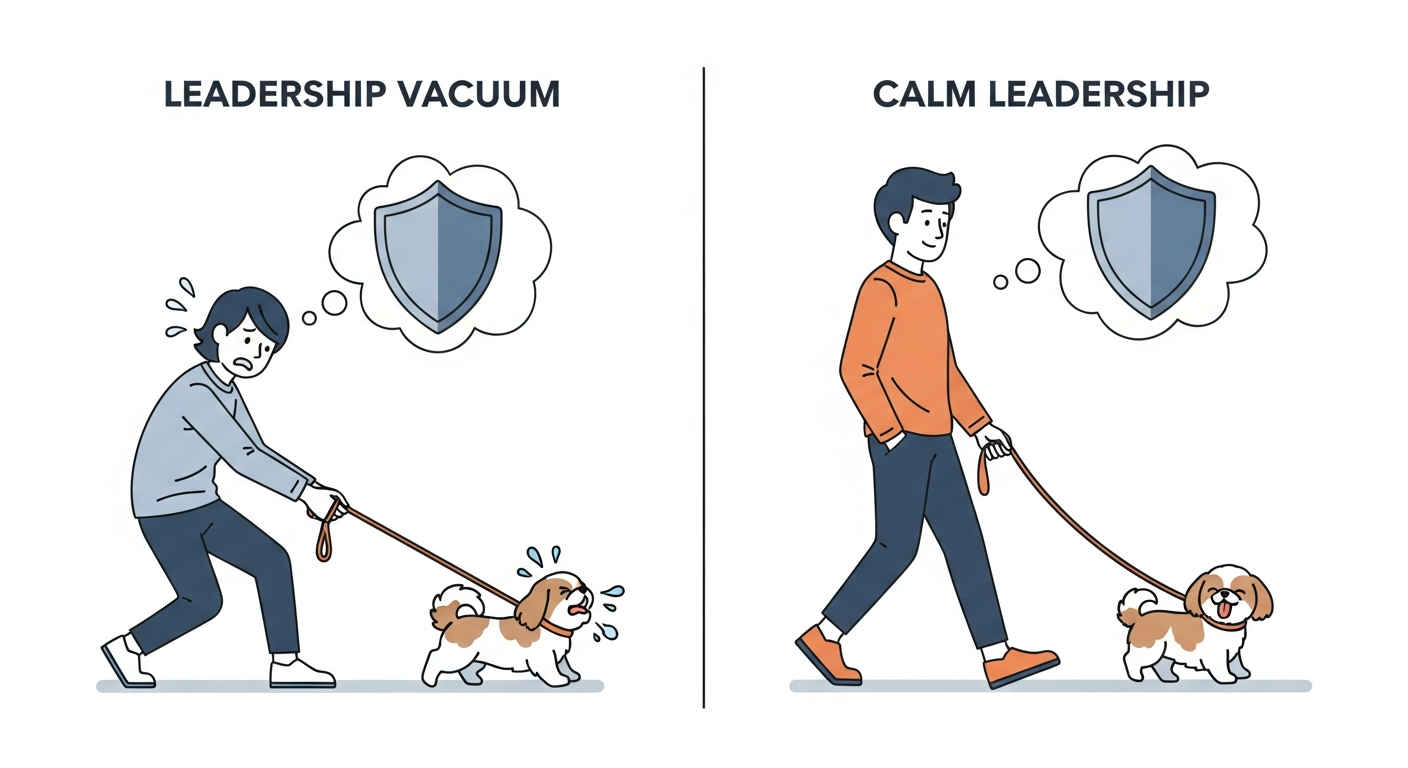
If you’re nervous on a walk, or you let your dog drag you around at the end of the leash, you’re telling your dog, without meaning to, that you can’t handle the situation.
So they step in.
This isn’t about dominating your dog.
It’s about giving them the security they’re currently trying to provide for themselves.
Every time you let your dog charge at another animal, you confirm that their alarm system was right to go off.
To them, a strange dog isn’t a potential friend, it’s a threat to defend against.
They walk up to them chest-up, head-up, tail-up and try to get them to back down.
When you show up calm and consistent instead, your dog gets to stop working and start just being a dog again.
Note that when your dog has puppies, the maternal instinct might cause your Shih Tzu to react in such a way to protect the puppy.
That is a separate situation all together.
Some dogs are naturally more dominant than others.
And there are some who tend to be more submissive.
It does not really matter what kind your Shih Tzu is.
The secret is this: YOU need to act as the Pack Leader.
Once you do this, you will find that all other training tricks will start to work.
A gentle pull on the leash, the distraction using a food treat, and the gentle word of warning.
The training approaches that you are currently using are probably excellent ones.
Training Tricks for a Calmer Shih Tzu
None of this changes the situation overnight, and none of it should feel like breaking your dog’s spirit.
Here are a few things that actually help.
• Food distractions
Keep high-value treats on hand.
The moment you spot a trigger, before your Shih Tzu reacts, redirect their attention with something worth paying attention to.
The key is this: use it as a distraction.
Do not reward your dog after they have lunged towards the oncoming dog.
Over time, they learn that looking at you pays off better than fixating on the other dog.
• Go slowly
Behavioral change takes weeks, not days.
Be consistent with whatever cues or words you use, and don’t push your dog into situations they’re not ready for; that usually sets you back further than it moves you forward.
Going slowly builds confidence.
• Get the walk right
If your dog pulls, check your gear first.
A properly fitted flat collar should communicate gently, not yank.
Leash pressure is guidance, not a correction tool.
• Watch your own energy
Dogs pick up on tension fast.
Stay loose, keep your voice steady, and focus on the behavior you want instead of reacting to the one you don’t.
Remember that you need to continue to show your dog exactly how you want him to behave.
• Step in early
Once you notice the early signs of tension, that’s your window to redirect with positive reinforcement, before things escalate.
Once you have done this, remember to relax immediately afterward.
If your dog keeps reacting despite consistent training, a professional trainer can look at your setup and figure out what’s missing.
Your Shih Tzu’s natural instincts
What I love about this whole method is that it works with your Shih Tzu’s natural instincts.
Shih Tzus are affectionate dogs, and they’re sensitive to what’s happening around them.
Before assuming a behavior problem is behavioral at all, it’s worth ruling out physical ones:
dental pain and joint issues are common, easy-to-miss causes of sudden aggression, and a vet visit should come before any training plan.
A few practical things help too:
• a dog gate gives your Shih Tzu somewhere to retreat to when the house gets loud, and
• interactive toys give them something to do with their energy.
If separation anxiety or territorial marking keeps coming up, remember you’re dealing with a family member, not a project.
What looks like dominance in a Shih Tzu is almost always insecurity, stress, or the absence of clear, calm leadership, not a power grab.
Once you drop the old “alpha” framing and focus on structured training and mutual trust, the behavior tends to shift.
It takes time, and it’s not linear.
Grooming sessions and gentle play are good ways to build the relationship alongside training.
Don’t compare your dog’s pace to anyone else’s; every dog gets there differently.
Training a dominant Shih Tzu does not have to be complicated.
Your Shih Tzu is just waiting for you to give him the right messages.
With consistency and patience, your Shih Tzu will eventually let you handle the leadership, and settle into being what they were always meant to be: a calm, secure companion.